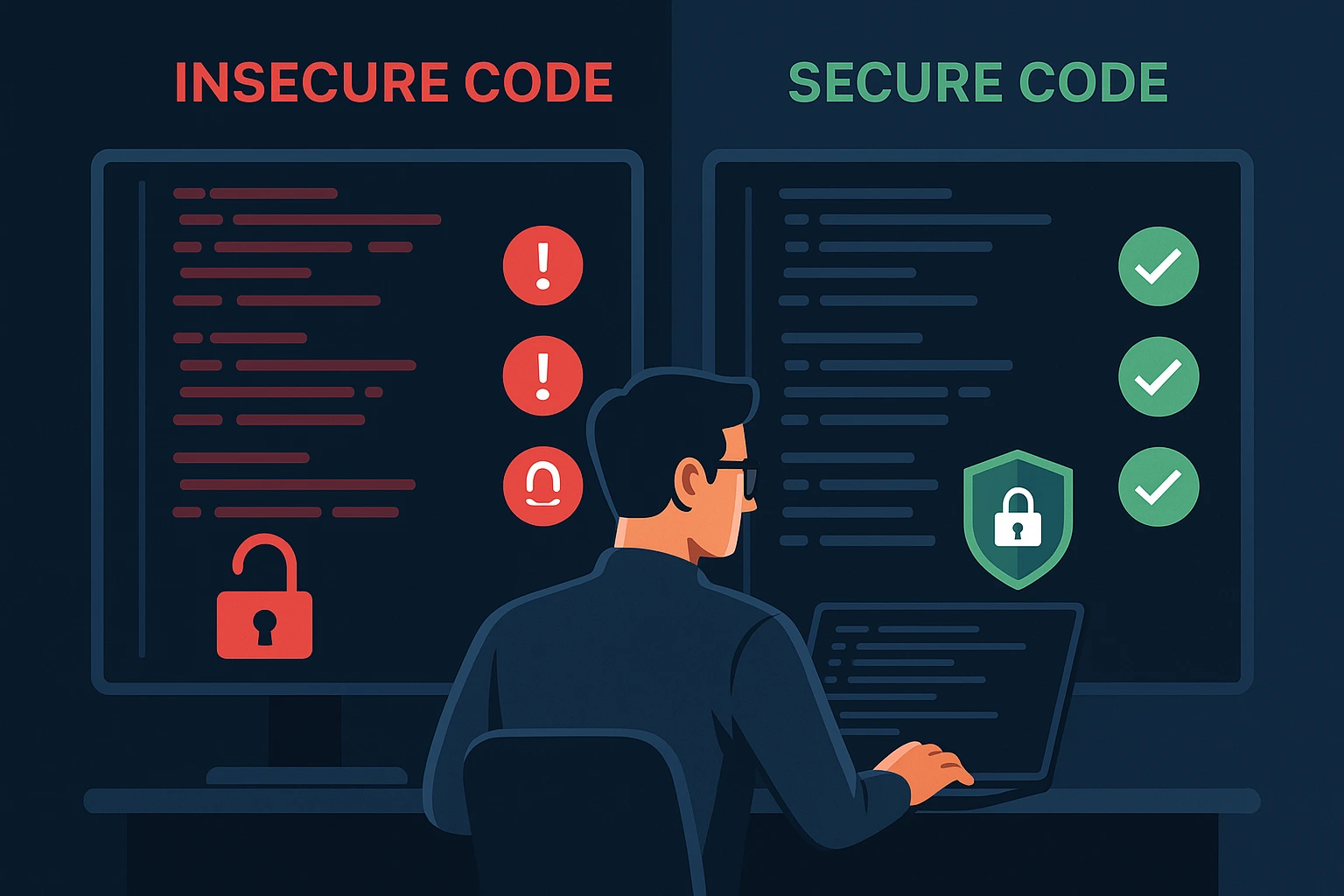
How to Safely Ship Your Vibe-Coded Website
How to Safely Ship Your Vibe-Coded Website?
With the rise of AI website builders like Lovable, Replit, and Builder.io, and AI tools like ChatGPT, Copilot, and Claude, building websites has become incredibly fast. You can now generate full-stack applications in days or even hours without deeply understanding every line of code. This style of development is often called “vibe coding.”
While vibe coding is exciting and empowering for many reasons—you have an idea in your head, you quickly build a website, and test whether that idea works without much cost (Lovable even provides free credits every day)—it also introduces serious security risks if you ship without proper review.
In this article, we’ll walk through what vibe coding really is, when security matters most, and what common attacks you should protect against.
What Is Vibe Coding?
Vibe coding is a modern development approach where developers, tech enthusiasts, founders, and hobby builders rely on AI tools to:
- Generate frontend and backend code
- Write APIs and database logic
- Build authentication systems
- Deploy applications quickly
Instead of deeply engineering every piece, you:
- Focus on what you want
- Let AI handle how it’s built
Types of Websites
We can categorize websites in many ways like e-commerce, CMS, financial websites, and more. But from a technical perspective, especially when we talk about vibe coding, we mainly deal with two types of websites.
Static Websites
Websites with the same type of data whenever you load the page, such as:
- Product information websites
- Landing pages for your company
- Portfolio websites
- Static documentation
Dynamic Websites (Web Applications)
These websites rely on a heavy amount of logic handled on the backend/frontend. The data changes as users interact with the app, such as:
- Full-featured platforms like Zomato or Airbnb (user accounts, data, payments)
- Dashboards and admin panels
- Payment systems
- SaaS platforms
- Internal company tools
If your website falls into the category of dynamic websites, then this blog is for you.
Do You Really Need to Worry About Website Security?
Short answer: Yes, absolutely, if your website is a dynamic website or web application.
Not, really, Static sites have very low risk, unless they contain exposed secrets or integrate dynamic third-party scripts.
Then a single vulnerability can lead to:
- Data leaks
- Account takeovers
- Financial loss
- Legal trouble
- Damage to your professional reputation
Even small side projects can become attack targets once they go live.
Common Attacks and Their Practical Solutions
Below are some of the most common real-world attacks you should protect against when shipping a vibe-coded app.
1. SQL Injection / Database Injection
Attack:
Hackers inject malicious SQL into your input fields to access or delete your database.
Example:
' OR 1=1 --Solution:
- Always use ORMs or parameterized queries
- Never directly pass user input into raw database queries
- Validate, limit, and sanitize all inputs
2. Cross-Site Scripting (XSS)
Attack: Malicious scripts are injected into your UI through user input and executed in other users’ browsers.
Solution:
- Escape all user-generated content
- Use trusted UI libraries
- Avoid inline scripts or switch to nonces/hashes when using CSP.
- Never use
dangerouslySetInnerHTMLwithout sanitizing
3. Authentication & Session Attacks
Attack: Attackers hijack sessions or brute-force weak passwords.
Solution:
- Enforce strong passwords
- Add rate limiting
- Enable 2FA / OTP
- Use secure HTTPS-only cookies
- Rotate JWT secrets regularly
4. Broken Access Control
Attack: Users gain access to admin routes or other users’ data.
Solution:
- Never trust the frontend for authorization
- Always validate permissions on the backend
- Use role-based access control (RBAC)
5. File Upload Vulnerabilities
Attack: Malicious files (scripts, malware) are uploaded and executed.
Solution:
- Restrict file types
- Validate MIME types
- Store uploads outside your main server
- Never allow executable uploads
6. API Abuse & Rate-Limit Attacks
Attack: A lack of rate limiting leaves your APIs exposed to spam attacks, service outages, brute-force attempts, and costly security incidents.
Solution:
- Add rate limiting
- Use CAPTCHAs
- Log suspicious activity
- Block abusive IPs
These are some of the most common attacks that usually happen on Web applications. Some are very technical, and some can be handled easily even while vibe coding.
In your initial prompt, mention these attacks as guardrails for your website. This gives your website builder platform and LLM enough context about what must always be avoided.
Guardrail Prompt:
When building or modifying this website, all features and code must follow these security rules. Do not produce implementations that violate them.

Database safety (SQL Injection):
Always use ORMs or parameterized queries. Never insert raw user input into SQL. Validate and limit all inputs.

XSS Protection:
Escape and sanitize all user-generated content before rendering. Do not inject raw HTML into the UI unless it is fully sanitized. Use a strict Content Security Policy.

Authentication & Sessions:
Enforce strong passwords, rate-limit login attempts, and support 2FA where possible. Store passwords using secure hashing. Use secure, HTTP-only cookies. Rotate JWT secrets and enforce expiration.

Access Control:
Never trust the frontend for authorization. Always validate permissions on the backend. Ensure users can only access their own data. Protect all admin routes with strict role checks.

File Upload Security:
Allow only whitelisted file types. Validate MIME types. Store uploads outside the main app. Never allow executable files.

API Abuse & Rate Limiting:
Apply rate limiting on all public APIs. Add CAPTCHA where abuse is possible. Log and block suspicious activity.

If any requested feature conflicts with these rules, the secure approach must always be chosen.
Final Thoughts
If you’re very new to development, the safest path is this:
-
Start building your product at your own comfort level
-
Provide clear guardrails to your vibe coding platform
-
Push your code to GitHub
-
If your app deals with critical data, hire a security-aware developer
-
Let them review:
- Authentication
- API security
- Database access
- Environment variable handling
- Deployment setup
Vibe coding is super efficient. So start building your dream project and see what real impact it can make in the real world.
Stay vigilant. Stay secure. And most importantly, enjoy vibe coding.