Picking the Right LLM: Balancing Cost, Quality, Latency, and Risk
Most teams don't fail because they chose a weak model. They fail because they chose the wrong model for the job. Here's the decision framework I use across real production systems.
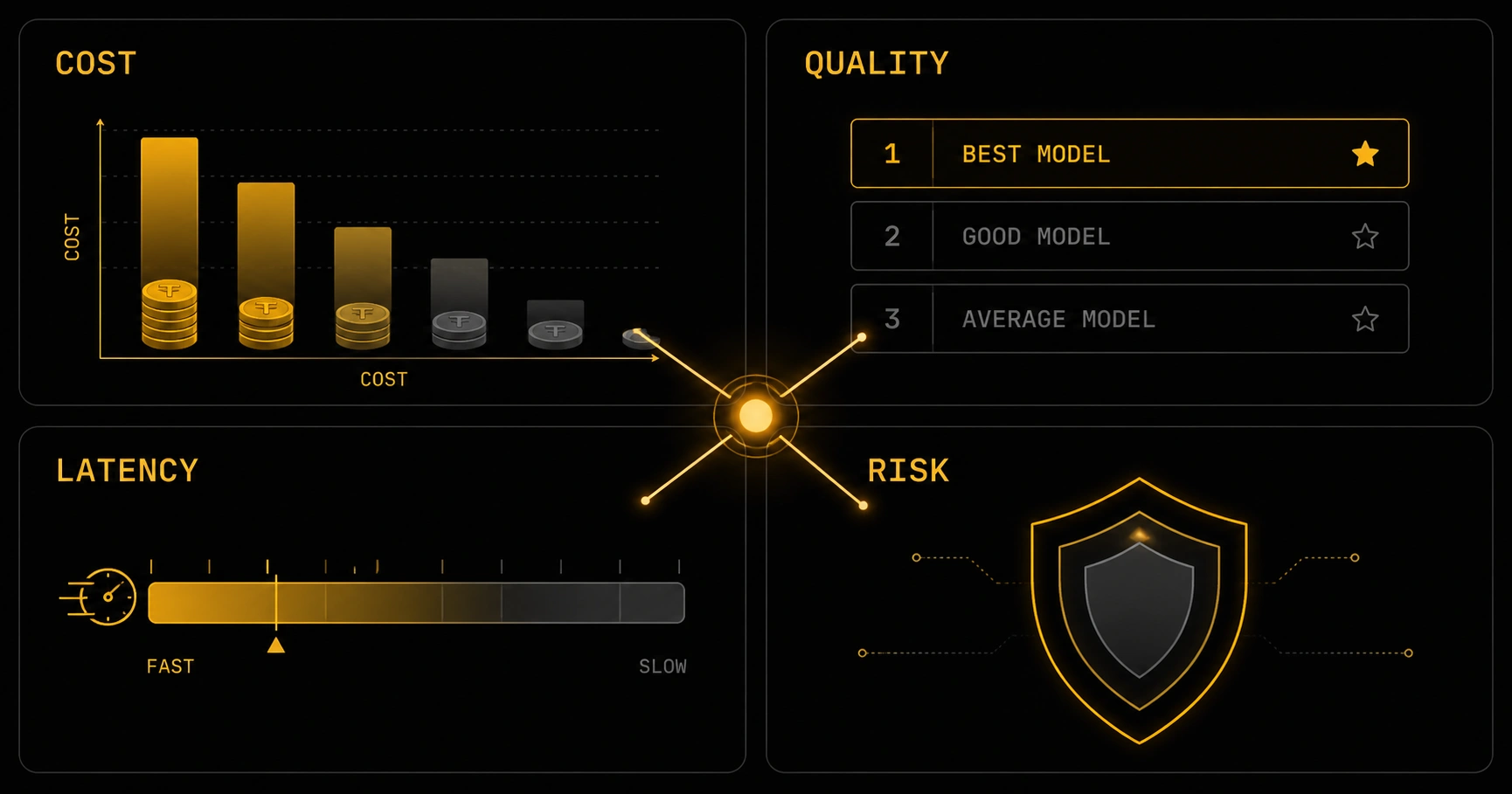
Picking the Right LLM: Balancing Cost, Quality, Latency, and Risk
The first time I seriously misjudged model selection was while building our AI Sales Agent at Capria.
The system had three distinct jobs: verify whether a lead is qualified, select which LinkedIn profiles are the right fit, and hold a personalized conversation with that lead. In the early version, we used one model for all three. It was a frontier model — expensive, capable, slow on volume. It worked. But the API cost per lead was painful, the throughput was bottlenecked, and when I started profiling, the biggest surprise was that the heaviest usage was on the cheapest task: selecting LinkedIn profiles. Simple relevance ranking was consuming the same budget as complex lead verification.
The fix wasn't finding a better model. It was realizing that each task had a completely different profile — different cost tolerance, different latency requirement, different consequence for getting it wrong. Once I split them and routed accordingly, costs dropped and throughput improved significantly without touching output quality for the tasks that actually needed it.
That's when the framing shifted for me. The question is never "which model is best?" It's: which model is best for this specific task, given your budget, your users, and the consequences of being wrong?
The Four Axes You're Actually Trading Off
Cost
Cost is more than the $/million tokens on the pricing page. At scale, it compounds in three places most teams underestimate:
- Token volume: long system prompts, multi-turn history, large context windows — all multiply fast
- Retry cost: hallucinations and malformed outputs trigger retries, which can double or triple effective spend
- Human review cost: if your use case requires a human to verify AI outputs, that labor is part of your model economics
The difference between model tiers is extreme. Based on benchmark data, running one million queries through a GPT-4 class model costs roughly $45 — versus $0.25 for Mistral 7B. That's a 180× difference. At enterprise scale — a million conversations per month at 500–1000 tokens each — you're looking at $15,000–$75,000/month for frontier models versus $150–$800 for smaller alternatives.
That gap makes a routing strategy mandatory, not optional.
Quality
Quality is not one thing. It has at least five distinct dimensions:
| Dimension | Where it matters most |
|---|---|
| Reasoning | Multi-step tasks, analysis, classification |
| Coding | Generation, debugging, structured output |
| Factual accuracy | Information retrieval, high-stakes decisions |
| Instruction following | Tool-calling, schema adherence |
| Long-context handling | Document analysis, large codebases |
A model that scores high on general benchmarks can still fail your specific workflow. GPT-4 scores 86.4% on MMLU — but Phi-3-mini hits 82% on GSM8K math tasks despite being a fraction of the size. Benchmarks are useful for shortlisting, not for final decisions.
A model that wins the leaderboard can still break your pipeline. Test on your data, not theirs.
Real-world evaluation against your actual task distribution is the only reliable signal. This is why LLM evaluation frameworks now treat static benchmarks as a starting point, not a verdict — production monitoring and task-specific evals matter more.
Latency
Latency is the dimension users feel directly, and the numbers are stark. Small models deliver chatbot responses in roughly 50ms; frontier models average around 800ms. That's a 16× difference. For a streaming chat UI, the gap is partially masked by token-by-token display. For any synchronous call that blocks a user action, it's unacceptable.
The hidden latency multiplier is context length. A 128k-token context window fed to a slow model doesn't just cost more — it takes proportionally longer. If your use case involves real-time interaction, defaulting to a long-context frontier model often costs you both latency and money simultaneously.
Three scenarios where latency should dominate your decision:
- Real-time chat and voice interfaces
- Code completion inside an IDE (users expect sub-100ms)
- Any synchronous pipeline that a user is waiting on
Risk
Risk is the axis that gets the least coverage and causes the most production incidents.
It has three layers:
Technical risk — hallucination rates, prompt injection vulnerability, model instability between API versions. Some models hallucinate confidently; others hedge appropriately. For high-stakes use cases in finance, healthcare, or legal, this isn't a quality preference — it's a liability question.
Business risk — vendor lock-in, surprise pricing changes, API downtime. Building a product entirely on one proprietary model means the vendor's pricing decisions become your margin decisions. Model portability is now a legitimate architecture requirement, not an overengineering concern.
Compliance risk — data residency, privacy regulations, training data provenance. Enterprise deployments in regulated industries often can't use consumer API endpoints at all — data must stay within a specific region or on-premise infrastructure.
The Decision Matrix I Actually Use
Before picking a model, I map the use case to its primary constraint:
| Use case | Primary axis | What I reach for |
|---|---|---|
| Customer support chatbot | Cost + latency | Small/mid-tier (Haiku, Flash, Llama 3 8B) |
| Code assistant | Quality + instruction following | Top-tier or specialized coding model |
| Enterprise RAG | Risk + accuracy | Mid-tier with source citations + audit trails |
| Agentic multi-step workflows | Quality + tool reliability | Claude Sonnet class |
| Batch data extraction | Cost + throughput | SLM or quantized local model |
| Real-time streaming UI | Latency | Flash-tier or Groq-hosted models |
| Regulated / confidential data | Risk | Self-hosted open-weight or Azure private endpoint |
Real Routing Decisions I've Made
AI Sales Agent — Three tasks, three different models
The system had three distinct jobs:
Lead verification — determining whether a prospect is worth pursuing. This requires structured reasoning: evaluate multiple signals, weigh them against criteria, make a confident binary decision. Getting this wrong costs pipeline quality downstream. We used Azure OpenAI o3 here. Expensive, yes — but the reasoning quality directly affected sales conversion. That's where a premium model pays for itself.
LinkedIn profile selection — ranking which profiles are a relevant fit from a candidate pool. This is high-volume and parallelizable. It's essentially relevance scoring, not deep reasoning. We routed this to Gemini — significantly cheaper, fast enough to process hundreds of profiles concurrently without queue buildup. This was where most of the token volume lived, and using o3 here was the original mistake.
Lead conversations — the actual outreach messaging layer. Personalized but templated enough that a mid-tier model handles it reliably. Routing this separately freed up o3 quota for where it actually mattered.
The dual-routing on selection + verification alone cut per-lead AI cost by over 60% without touching qualification accuracy.
Portfolio VA — Gemini Flash → Groq fallback
My portfolio's virtual assistant uses Gemini 1.5 Flash as the primary model: fast, cheap, and good enough for FAQ-style conversation. If the Gemini gateway returns an error, the system immediately falls back to Groq running Llama 3. The reason Groq specifically — not another Gemini endpoint, not GPT-4o-mini — is latency. Groq's inference runs at several hundred tokens per second, often 10× faster than hosted frontier models. For a streaming chat fallback, speed matters more than marginal quality difference.
MCP Budget Server — Claude for tool-calling reliability
When building the MCP Budget Server (28 tools, natural language financial commands), I evaluated three models for tool-calling reliability. Claude 3.5 Sonnet won — not because it's the smartest, but because it follows structured tool schemas consistently. Other models occasionally hallucinate argument names or skip required fields. In a system where a malformed tool call could corrupt a financial record, that reliability differential is not a quality preference — it's a correctness requirement.
Models vs Platforms: A Distinction That Matters
This trips up a lot of developers early. Grok and Gemini are models (or model families) — you interact with them via API, they run on someone else's infrastructure. Ollama and Hugging Face are platforms — they're how you access and run models, including many open-weight ones, locally.
The distinction changes your decision calculus. Picking a model is a capability trade-off. Picking a platform is a control, privacy, and infrastructure trade-off.
| Cloud Models | Local Platforms | |
|---|---|---|
| Examples | GPT-4o, Claude Sonnet, Gemini Flash, Grok | Ollama (Llama, Qwen, Gemma), HF Inference |
| Latency | Dependent on API + network | Sub-50ms possible on capable hardware |
| Cost | Per-token billing | Hardware + electricity only |
| Privacy | Data leaves your infrastructure | Stays fully local |
| Maintenance | Zero | You own updates and compatibility |
For internal tooling at a company handling confidential data, a locally-hosted Llama 3 via Ollama can be the right call even if its benchmark scores trail GPT-4o-mini. The risk axis wins.
Two Models Worth Watching Right Now
Kimi K2.5 — 256k token context window, strong on coding and agentic tasks. Its standout feature is parallel agent orchestration: it can spawn and coordinate up to 100 sub-agents simultaneously, cutting execution time by up to 4.5× on complex multi-step workflows. Worth evaluating if you're building agentic pipelines and running into coordination or context limits with standard models.
OpenAI's open-weight models (gpt-oss, 20B and 120B variants) — designed for local and developer deployment. The significance is the signal: OpenAI is now competing in the open-weight space, which changes the viability of self-hosted deployments for enterprise teams that have been locked out by data residency requirements.
Model Cheat Sheet: What Each One Is Best For
Here's how the major models map across all four axes. The All 4 column marks models that hold up reasonably well everywhere — not perfect at anything, but no critical weak spot that disqualifies them for a general use case.
| Model | Best Fit | Cost | Quality | Latency | Risk | All 4 |
|---|---|---|---|---|---|---|
| GPT-4o | General-purpose, balanced tasks | $$ | High | Medium | Low | ✅ |
| GPT-4o-mini | High-volume, low-complexity | $ | Medium | Fast | Low | — |
| o3 | Deep reasoning, analysis, decisions | $$$$ | Very High | Slow | Low | — |
| Claude Sonnet 3.5 | Tool-calling, agentic, structured output | $$ | Very High | Medium | Very Low | ✅ |
| Claude Haiku | Budget tasks, simple Q&A | $ | Medium | Fast | Very Low | — |
| Gemini 1.5 Flash | Streaming, multimodal, high-volume | $ | High | Very Fast | Low | ✅ |
| Gemini 1.5 Pro | Long-context, balanced enterprise | $$ | High | Medium | Low | ✅ |
| Groq + Llama 3 8B | Ultra-low latency, real-time | Free / $ | Medium | Ultra Fast | Medium | — |
| Llama 3 70B (Ollama) | Privacy, self-hosted, offline | Free | High | Hardware-dependent | Very Low | — |
| Mistral 7B | Lightweight, efficient, local | Free / $ | Medium | Fast | Medium | — |
| Kimi K2.5 | Agentic workflows, 256k context | $$ | High | Medium | Low | — |
Cost key: $ = very cheap · $$ = moderate · $$$$ = expensive
If you don't have a dominant constraint and need a single model that won't embarrass you on any axis, these four consistently hold up: GPT-4o, Claude Sonnet 3.5, Gemini 1.5 Flash, and Gemini 1.5 Pro. Each one balances cost, quality, latency, and risk without a critical weakness in any single dimension.
A Simple Mental Model for Picking
Start with eliminations, not selections:
- Does the task involve regulated data or require on-premise deployment? → eliminate all cloud-only options
- Is response time under 200ms required? → eliminate frontier models, evaluate SLMs and Groq-hosted options
- Is this high-volume and low-stakes? → eliminate everything above mid-tier
- Does tool-calling or structured output correctness matter critically? → Claude class; run evals before committing
- Is budget the binding constraint? → start with the cheapest model that passes your eval threshold, not the best model that fits your budget ceiling
There is no universally best LLM. The right choice depends on the trade-off you're willing to make. Pick the model that optimizes your problem — not the one dominating the leaderboard this week.
Whatever you decide, build with model portability in mind from day one. Abstract your model calls behind a consistent interface. The vendor that's cheapest today may reprice next quarter, and the model that leads the benchmarks today will be superseded in months.
Final Thoughts
Model selection is an engineering decision, not a prestige decision. The teams shipping reliable AI products aren't necessarily using the most powerful models — they're using the right model for each layer of their system. Cost where cost matters, quality where quality matters, latency where users feel it, risk-awareness wherever the stakes are high.
Map your constraints first. Then pick your model.